The Creation Story
Culture

The foundation of Raketti is built on the idea of "people first" (even onto thin ice). Where does this stem from, and why is laziness sometimes a brilliant motivator?
In the beginning, in the year of our Lord 2011, there were five friends, the soot-stained ruins of a start-up, and a shared goal to avoid unpleasant day jobs. What to do next? Should we get real jobs?
Not on your life. Instead, Rakettitiede was founded.
“The first year was a period of searching,” says Juha Huttunen, the beloved leader and one of the founders of Raketti. “We didn't have any grand vision, we just lacked a workplace where we wanted to work. By selling consulting, we bought more time to figure out what we wanted to do when we grew up.”
The founders – Arttu, Kalle, Juha, Jarno and Marko – and the company with them have already grown, if not big then medium-sized, but the core idea is still alive and kicking: we offer challenges that the developer wants to choose, and once the choice is sealed, we cherish the developer like a delicate flower physically, professionally and mentally.
Swamp soccer style growth entrepreneurship
Alongside the consulting business, during the first years we developed ideas together for start-ups, and the ones that didn't work were used to heat the Shutdown Sauna.
“The intention was to grow the business and keep the engine running. At some point, it turned out that there were so many consultants that it became the number one focus, and we shut down the start-up incubator,” Juha says.
However, not everyone who could code was hired.
“The criteria for hiring new people were already tough back then; the consultant had to be technically skilled, enthusiastic, and not afraid of hard work, as well as understand the customer's business.”
We have been rowing with this model for 11 years now, and Raketti's course is not going to change in terms of business or the level of developers in the future either: we exist so that the best expertise is utilised in the best possible way.
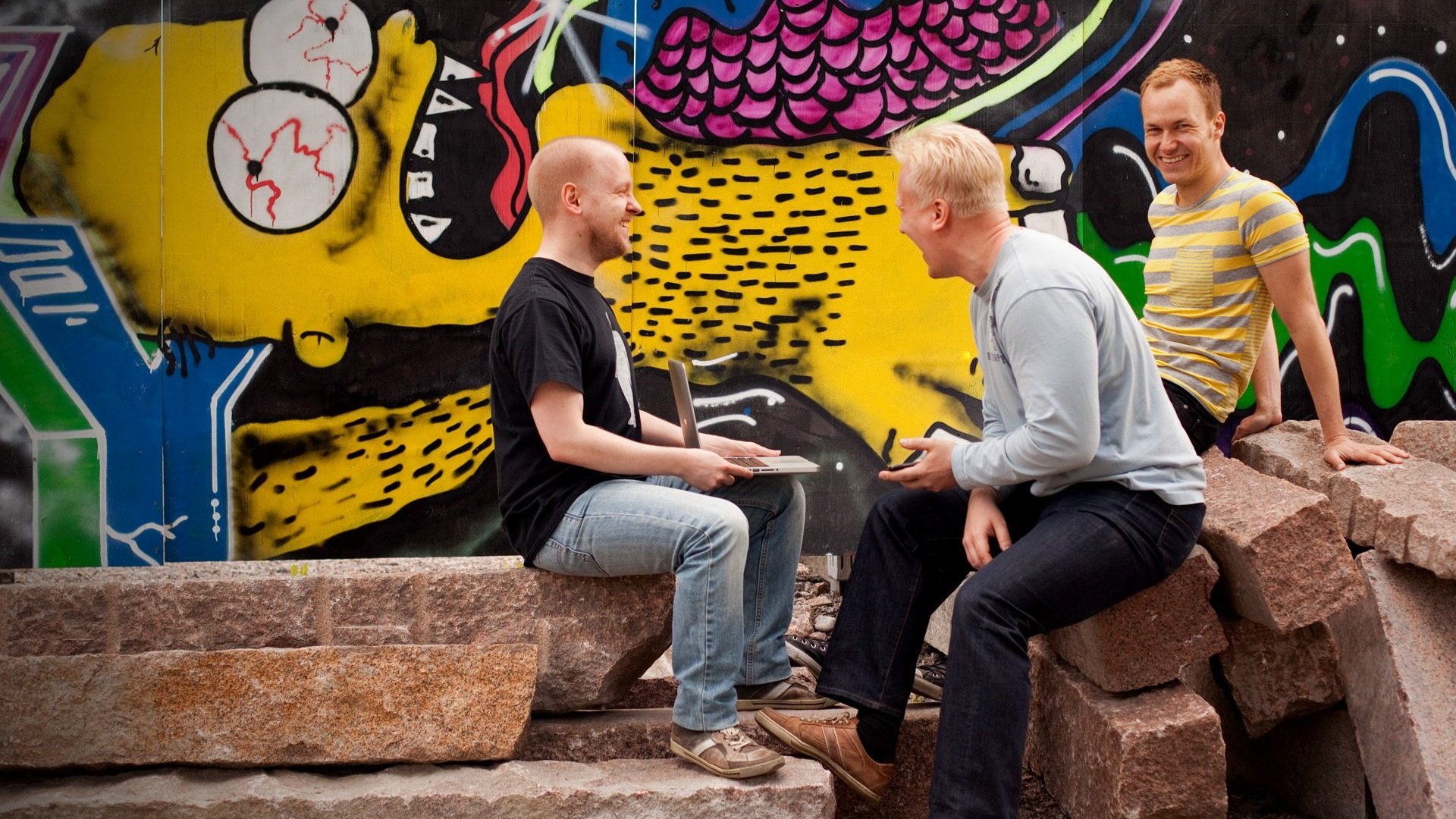
The founders – pictured Arttu, Juha and Kalle in 2011 – and the company with them have grown, but the core idea is still alive and kicking: we offer challenges that the developer wants to choose, and once the choice is sealed, we cherish the developer like a delicate flower physically, professionally and mentally.
Work smart, not hard
Since the preface of the company history, Rakettitiede's basic idea has been to offer good people a good salary for good work.
“This stems from the huge differences in productivity among developers: software is not coded by an anonymous resource but by a human being. A top developer or a small team of good professionals can deliver finished services in the same time that others are still shaping their army of coders,” Juha says.
He admits that there were other motivators for the salary model (in short: 50% of the billing goes to the consultant, read more here) besides fairness.
“Yes, my own laziness has also been a driver here. There is no need for separate salary negotiations, and since we pay as good a salary as we can, no one leaves because of that, at least,” Juha says and continues: “We want to find interesting things for developers to do. When that and the salary are right, there's no need to waste time fighting fires.”
So, part of the Raketti culture is that every space scientist gets to choose their own place and assignment – that's when top quality is born. If heading out to a gig on a weekday morning feels miserable, the bad vibe will start to show in the quality of the work.
“Programming is a craft, and it has to feel meaningful in order to create solutions and code that the customer is willing to pay for. That's why everyone here gets to influence which project they go into.”
Our business is selling software developers, but that doesn't mean faceless consultant trading. The customer knows today and tomorrow that they will get the best possible quality from us, and one reason for this is that our people are fired up by their work.
Practice what you preach
Our most important values are respecting others, transparency, professionalism, cooperation, learning and, essentially, a “no bullshit” attitude.
In reality, no values were planned; they were taught by the school of hard knocks.
“When I was on other people's payrolls, I experienced a culture where information was not shared openly as bad. Even though the companies were small fry, they were hierarchical and there was no opportunity to influence. In my opinion, the person presenting the idea doesn't matter, as long as the idea works. Actually, all our values come from our personalities: we are just like this, and our way of treating everyone fairly is highlighted by the not-so-nice experiences from previous jobs,” Juha states.
So is everyone cut from the same cloth?
“No. There are many idealists in the company and then some pragmatists like me, but we agree on fundamental things. If we were too similar, we wouldn't have such a diverse crossbreed as we do now, meaning different perspectives wouldn't be taken into account.”
Star Wars doesn't work
And where does the name Rakettitiede (Rocket Science) come from?
According to Juha, there is no great mystery to the name, but it was invented “not drunk but as a joke, although it does work”. Fortunately, Avaruussota (Space War), which won the silver cup in the naming competition, remained a runner-up forever.